Original: $6.61
-65%$6.61
$2.31The Story
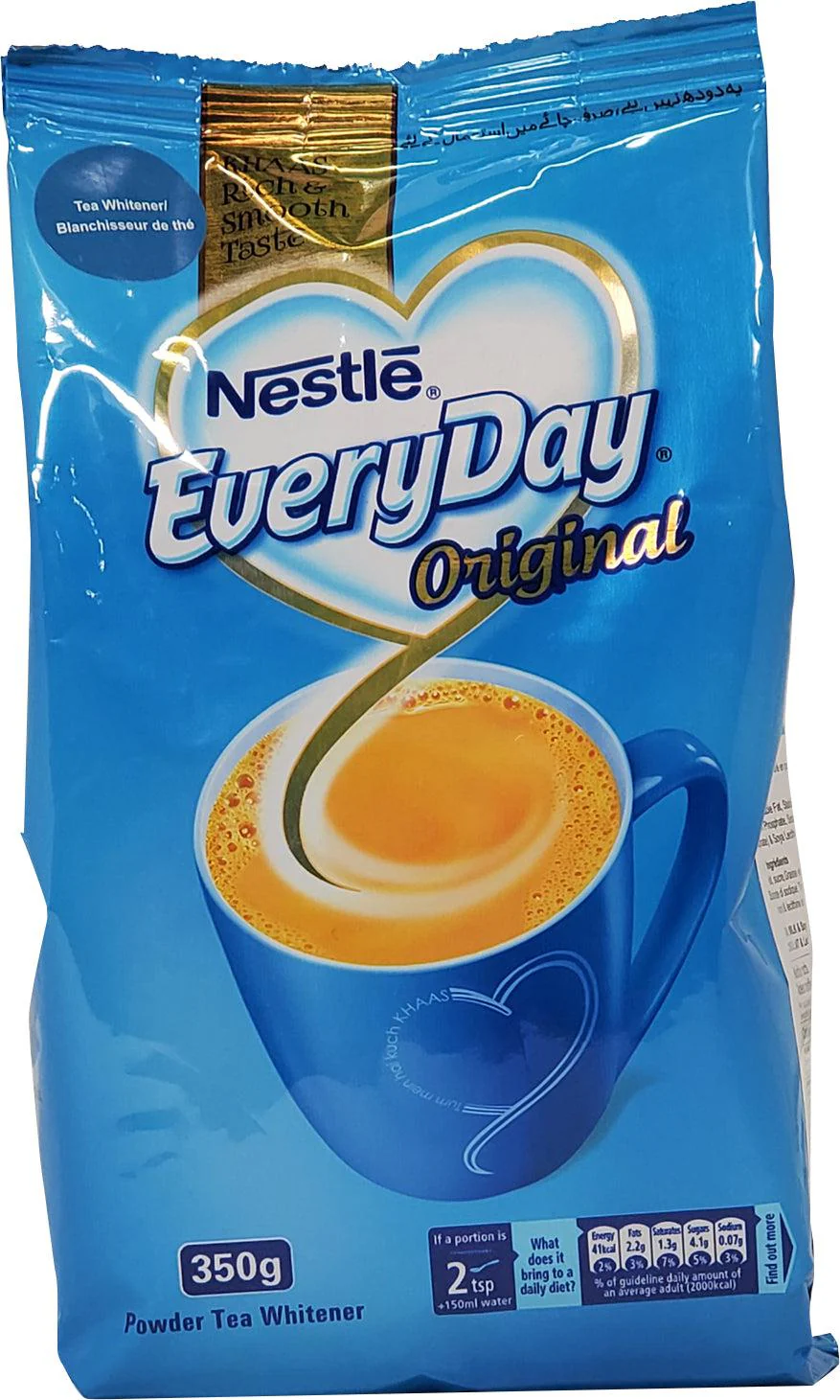
Nestle Everyday Tea Whitener 350g in Bulk | Delivered Across Canada
Nestle Everyday coffee and tea whitener is a non-dairy creamer alternative available in 350 g canisters, with cases containing 24 units (8.4 kg total). This powdered whitener serves as a shelf-stable option for lightening hot beverages in commercial foodservice and hospitality settings. Delivery is available across Canada.
Product Overview
Nestle Everyday is a powdered coffee and tea whitener formulated to dissolve in hot beverages without refrigeration requirements. The product comes in a resealable canister format designed for counter or service station placement.
Container specifications:
- Individual canister size: 350 g
- Case configuration: 24 canisters
- Total case weight: 8.4 kg
- Format: Powder in resealable plastic canister
Common Commercial Applications
Coffee and tea whiteners are used across various commercial settings where beverage service is provided.
Typical users include:
- Office buildings and corporate break rooms
- Hotels and hospitality facilities
- Restaurants and casual dining establishments
- Cafeterias and institutional dining facilities
- Conference centres and meeting venues
- Catering operations and event services
- Healthcare facilities and hospitals
- Educational institutions
- Retail locations with customer beverage stations
- Food trucks and mobile service operations
Functional Characteristics
Product format:
- Powdered consistency
- Dissolves in hot liquids
- Room temperature storage
- No refrigeration required before or after opening
Usage applications:
- Coffee whitening and flavour modification
- Tea service complement
- Hot chocolate and specialty beverage preparation
- Self-serve beverage stations
- Individual portion packets alternative
Operational advantages:
- Extended shelf life compared to dairy cream
- Reduced cold storage requirements
- Lower product waste from spoilage
- Consistent portion control
- Simplified inventory management
Storage and Handling
Proper storage maintains product quality and extends usability:
- Store in cool, dry location away from moisture
- Keep canister lid tightly sealed when not in use
- Protect from direct heat sources
- Use clean, dry utensils for dispensing
- Implement first-in, first-out rotation
- Check expiration dates during receiving
Shelf life considerations: Unopened canisters maintain quality throughout the manufacturer's specified date when stored according to guidelines. Once opened, reseal promptly and use within a reasonable timeframe based on usage volume.
Service and Dispensing
Counter service applications:
- Place canisters at coffee stations or beverage prep areas
- Position near hot water dispensers or coffee makers
- Provide small spoons or scoops for customer self-service
- Label clearly for customer identification
Portion control: Usage amounts vary by individual preference. Typical serving ranges from 1-3 teaspoons per 250 ml cup. Operations may establish standard measurements for consistency.
Bulk Purchasing Considerations
Case quantity benefits:
- Reduces ordering frequency
- Supports high-volume operations
- Provides backup inventory during peak periods
- Facilitates centralized purchasing for multi-location operations
Storage requirements: A case of 24 canisters requires approximately 1.5 cubic feet of dry storage space. Calculate storage needs based on typical consumption rates and reorder cycles.
Usage estimation: Consumption varies based on:
- Number of daily beverage servings
- Customer preference for whitener
- Average amount used per serving
- Service model (self-serve vs. prepared beverages)
Frequently Asked Questions
1. What is the difference between coffee whitener and dairy cream?
Coffee whitener is a non-dairy powder that does not require refrigeration, while dairy cream is a perishable liquid product. Whitener dissolves in hot beverages, has extended shelf life, and contains different ingredients than dairy cream.
2. Does this product contain lactose?
Check the specific product label for current ingredient information. Some non-dairy whiteners may contain milk derivatives. Contact the manufacturer or review packaging for allergen statements.
3. How long does an opened canister last?
Opened canisters should be resealed after each use and stored in dry conditions. Usage timeline depends on volume and environmental factors. Monitor for any changes in colour, texture, or smell that would indicate quality degradation.
4. Can this be used in cold beverages?
This product is formulated to dissolve in hot liquids. It may not fully dissolve in cold beverages. For iced drinks, dissolving in a small amount of hot liquid first before adding to cold beverage may improve results.
5. Is this product vegan?
Check current product labelling for ingredient specifications. Formulations may vary and ingredient statements provide accurate information about dairy derivatives or animal-based ingredients.
6. What is the recommended serving size?
Serving size varies by individual taste preference. Typical usage ranges from 1-3 teaspoons per 250 ml cup. Provide measuring options for consistency if desired.
7. Does this product need to be refrigerated after opening?
No, this powdered whitener does not require refrigeration. Store in a cool, dry place with the lid tightly sealed to prevent moisture exposure and maintain quality.
8. How many servings are in one 350 g canister?
Serving count varies based on individual usage amounts. At approximately 2 teaspoons per serving, one canister provides roughly 70-100 servings. Actual yield depends on portion sizes.
9. Can this replace milk in recipes?
This product is specifically formulated as a beverage whitener. It is not designed as a milk substitute in cooking or baking applications. Use according to intended purpose.
10. What causes clumping in powdered whitener?
Moisture exposure causes clumping in powdered products. Keep the canister tightly sealed, use dry utensils, and store in low-humidity environments. Clumped product may still be usable if no other quality issues are present.
Businesses purchasing Nestle Everyday coffee/tea whitener in case quantities should assess their typical beverage service volume, available dry storage space, and rotation capabilities. The 24-canister case format suits operations with consistent whitener usage while the shelf-stable nature reduces refrigeration demands. Consider consumption patterns and service model when determining appropriate stock levels for your facility.
Details & Craftsmanship
Every detail has been carefully considered to bring you the perfect product.
Description
Nestle Everyday Tea Whitener 350g in Bulk | Delivered Across Canada
Nestle Everyday coffee and tea whitener is a non-dairy creamer alternative available in 350 g canisters, with cases containing 24 units (8.4 kg total). This powdered whitener serves as a shelf-stable option for lightening hot beverages in commercial foodservice and hospitality settings. Delivery is available across Canada.
Product Overview
Nestle Everyday is a powdered coffee and tea whitener formulated to dissolve in hot beverages without refrigeration requirements. The product comes in a resealable canister format designed for counter or service station placement.
Container specifications:
- Individual canister size: 350 g
- Case configuration: 24 canisters
- Total case weight: 8.4 kg
- Format: Powder in resealable plastic canister
Common Commercial Applications
Coffee and tea whiteners are used across various commercial settings where beverage service is provided.
Typical users include:
- Office buildings and corporate break rooms
- Hotels and hospitality facilities
- Restaurants and casual dining establishments
- Cafeterias and institutional dining facilities
- Conference centres and meeting venues
- Catering operations and event services
- Healthcare facilities and hospitals
- Educational institutions
- Retail locations with customer beverage stations
- Food trucks and mobile service operations
Functional Characteristics
Product format:
- Powdered consistency
- Dissolves in hot liquids
- Room temperature storage
- No refrigeration required before or after opening
Usage applications:
- Coffee whitening and flavour modification
- Tea service complement
- Hot chocolate and specialty beverage preparation
- Self-serve beverage stations
- Individual portion packets alternative
Operational advantages:
- Extended shelf life compared to dairy cream
- Reduced cold storage requirements
- Lower product waste from spoilage
- Consistent portion control
- Simplified inventory management
Storage and Handling
Proper storage maintains product quality and extends usability:
- Store in cool, dry location away from moisture
- Keep canister lid tightly sealed when not in use
- Protect from direct heat sources
- Use clean, dry utensils for dispensing
- Implement first-in, first-out rotation
- Check expiration dates during receiving
Shelf life considerations: Unopened canisters maintain quality throughout the manufacturer's specified date when stored according to guidelines. Once opened, reseal promptly and use within a reasonable timeframe based on usage volume.
Service and Dispensing
Counter service applications:
- Place canisters at coffee stations or beverage prep areas
- Position near hot water dispensers or coffee makers
- Provide small spoons or scoops for customer self-service
- Label clearly for customer identification
Portion control: Usage amounts vary by individual preference. Typical serving ranges from 1-3 teaspoons per 250 ml cup. Operations may establish standard measurements for consistency.
Bulk Purchasing Considerations
Case quantity benefits:
- Reduces ordering frequency
- Supports high-volume operations
- Provides backup inventory during peak periods
- Facilitates centralized purchasing for multi-location operations
Storage requirements: A case of 24 canisters requires approximately 1.5 cubic feet of dry storage space. Calculate storage needs based on typical consumption rates and reorder cycles.
Usage estimation: Consumption varies based on:
- Number of daily beverage servings
- Customer preference for whitener
- Average amount used per serving
- Service model (self-serve vs. prepared beverages)
Frequently Asked Questions
1. What is the difference between coffee whitener and dairy cream?
Coffee whitener is a non-dairy powder that does not require refrigeration, while dairy cream is a perishable liquid product. Whitener dissolves in hot beverages, has extended shelf life, and contains different ingredients than dairy cream.
2. Does this product contain lactose?
Check the specific product label for current ingredient information. Some non-dairy whiteners may contain milk derivatives. Contact the manufacturer or review packaging for allergen statements.
3. How long does an opened canister last?
Opened canisters should be resealed after each use and stored in dry conditions. Usage timeline depends on volume and environmental factors. Monitor for any changes in colour, texture, or smell that would indicate quality degradation.
4. Can this be used in cold beverages?
This product is formulated to dissolve in hot liquids. It may not fully dissolve in cold beverages. For iced drinks, dissolving in a small amount of hot liquid first before adding to cold beverage may improve results.
5. Is this product vegan?
Check current product labelling for ingredient specifications. Formulations may vary and ingredient statements provide accurate information about dairy derivatives or animal-based ingredients.
6. What is the recommended serving size?
Serving size varies by individual taste preference. Typical usage ranges from 1-3 teaspoons per 250 ml cup. Provide measuring options for consistency if desired.
7. Does this product need to be refrigerated after opening?
No, this powdered whitener does not require refrigeration. Store in a cool, dry place with the lid tightly sealed to prevent moisture exposure and maintain quality.
8. How many servings are in one 350 g canister?
Serving count varies based on individual usage amounts. At approximately 2 teaspoons per serving, one canister provides roughly 70-100 servings. Actual yield depends on portion sizes.
9. Can this replace milk in recipes?
This product is specifically formulated as a beverage whitener. It is not designed as a milk substitute in cooking or baking applications. Use according to intended purpose.
10. What causes clumping in powdered whitener?
Moisture exposure causes clumping in powdered products. Keep the canister tightly sealed, use dry utensils, and store in low-humidity environments. Clumped product may still be usable if no other quality issues are present.
Businesses purchasing Nestle Everyday coffee/tea whitener in case quantities should assess their typical beverage service volume, available dry storage space, and rotation capabilities. The 24-canister case format suits operations with consistent whitener usage while the shelf-stable nature reduces refrigeration demands. Consider consumption patterns and service model when determining appropriate stock levels for your facility.